
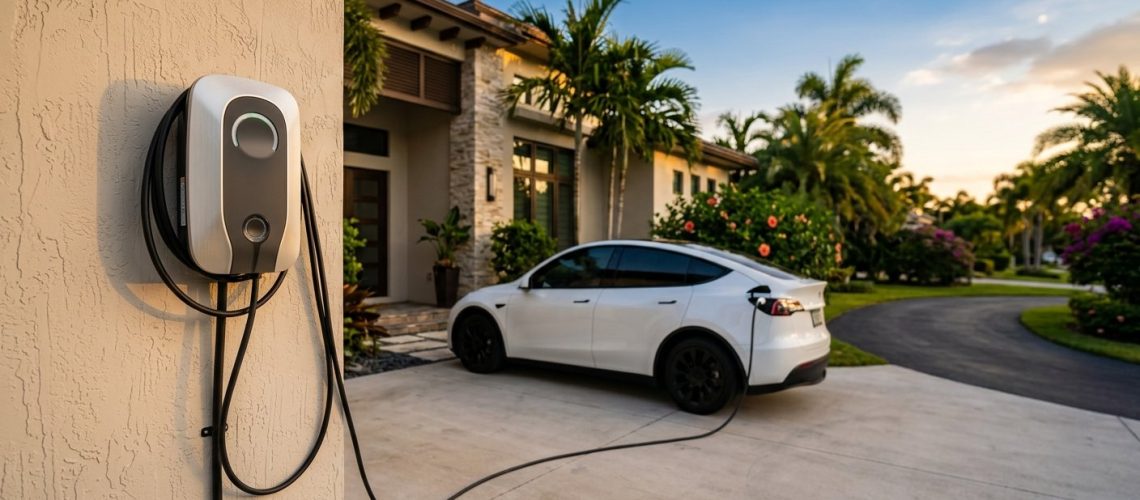
Installing a home EV charging station requires assessing your electrical panel’s capacity, selecting the right charger level, and having a licensed electrician run a dedicated circuit. Most South Florida homes with panels rated at 200 amps can accommodate a Level 2 EV charger, but older homes with 100-amp or Federal Pacific panels almost always need an upgrade first. The process typically takes one day when the panel is already sufficient.
- Level 2 EV chargers (240V) are the practical standard for home charging — they deliver a full charge overnight vs. several days with a standard outlet.
- Your electrical panel must have capacity to spare before a dedicated 50-amp circuit can be safely added.
- South Florida’s humidity and storm exposure affect outdoor charger placement and wiring requirements.
- Permits are required for EV charger installation in Palm Beach, Broward, and Miami-Dade counties — skip them and you risk insurance complications.
- An electrical panel upgrade and EV charger installation can be combined in one project, saving time and labor costs.
Why Level 2 Is the Right Choice for South Florida Homeowners
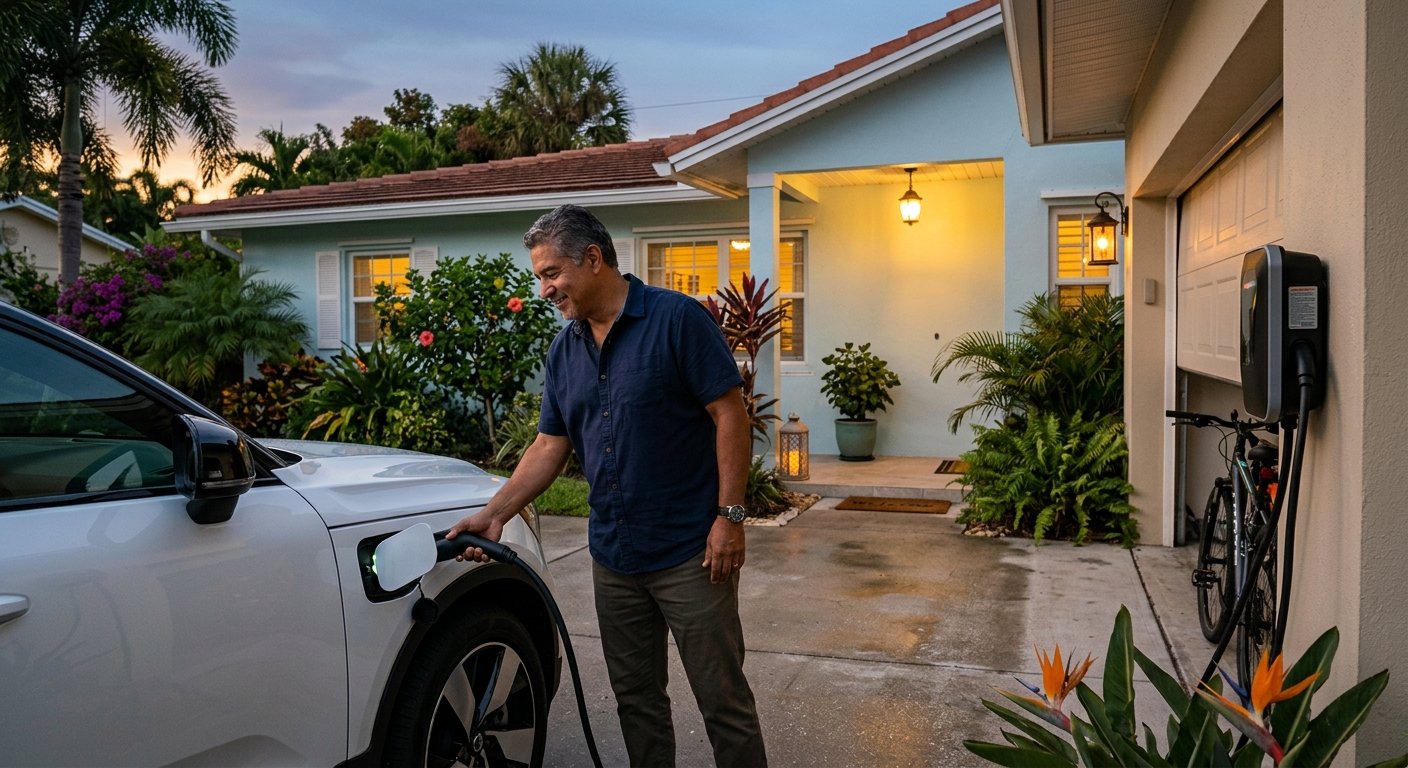
A standard 120V household outlet — what the industry calls a Level 1 charger — delivers roughly 3 to 5 miles of range per hour of charging. For most EV drivers in Palm Beach, Broward, or Miami-Dade counties who commute daily, that math simply doesn’t work. A Level 2 EV charger operates on 240V and can add 20 to 30 miles of range per hour, meaning a fully depleted battery is typically restored overnight.
According to the U.S. Department of Energy, the vast majority of EV charging happens at home, making the quality of your home setup the single most important factor in your day-to-day experience as an EV owner. Investing in a proper Level 2 installation isn’t an upgrade — for most drivers, it’s a necessity.
Look for ENERGY STAR-certified Level 2 chargers with smart scheduling features. They allow you to charge during off-peak utility hours, which can meaningfully reduce your monthly electricity bill over time.
| Charging Level | Level 1 (120V) | Level 2 (240V) |
|---|---|---|
| Outlet type | Standard household | Dedicated 240V circuit |
| Miles added per hour | 3–5 miles | 20–30 miles |
| Full charge time (typical EV) | 24–40 hours | 6–10 hours |
| Electrician installation required | No (if outlet exists) | Yes — dedicated circuit needed |
| Permit required in South FL | Generally no | Yes |
Start Here: Evaluating Your Electrical Panel
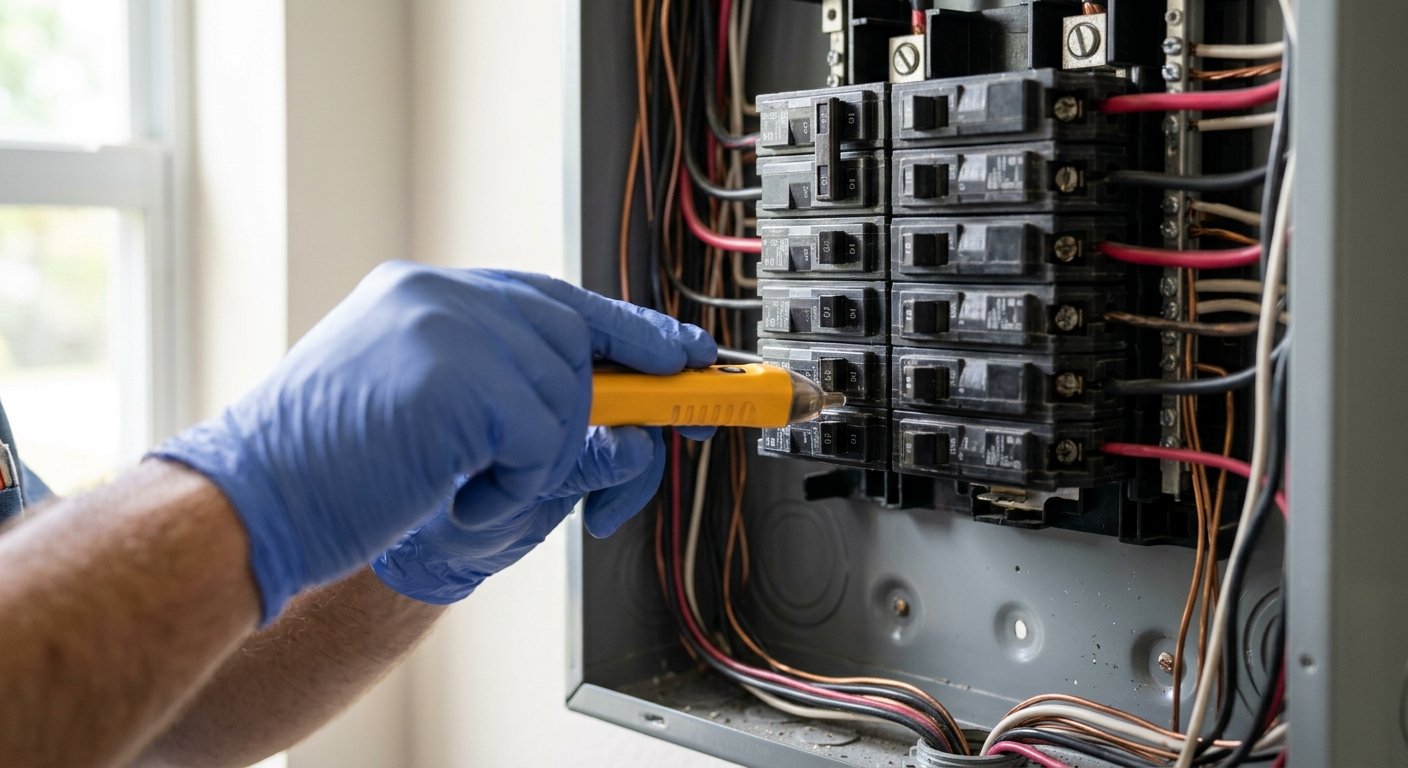
Before any charger is ordered or mounted, the electrical panel is the first thing a qualified ev charger electrician will examine. A Level 2 charger typically requires a dedicated 40- to 50-amp double-pole breaker. If your panel is already near capacity — running air conditioning, a pool pump, electric appliances, and other loads common to South Florida homes — there may simply not be enough headroom to add that circuit safely.
Signs Your Panel May Need an Upgrade First
- Your panel is rated at 100 amps or less. Modern households routinely need 200 amps, and adding an EV charger to an undersized panel is a fire and safety risk.
- You have a Federal Pacific or Zinsco panel. These older brands have well-documented reliability issues and should be replaced regardless of EV plans. Learn more about the full process on our electrical panel upgrades page.
- Breakers trip frequently. Nuisance tripping under normal loads is a sign your panel is already overworked.
- No open breaker slots remain. A tandem breaker is not a safe workaround for a high-draw EV circuit.
If your panel checks out, the next step is running a dedicated circuit from the panel to your garage, carport, or designated parking area. This is not a DIY project — pulling permits, running conduit, and making panel connections all require a licensed electrical contractor under Florida building code.
The panel assessment is the step homeowners most often skip — and the one that most often turns a simple install into an emergency repair.
Permit Requirements in Palm Beach, Broward, and Miami-Dade
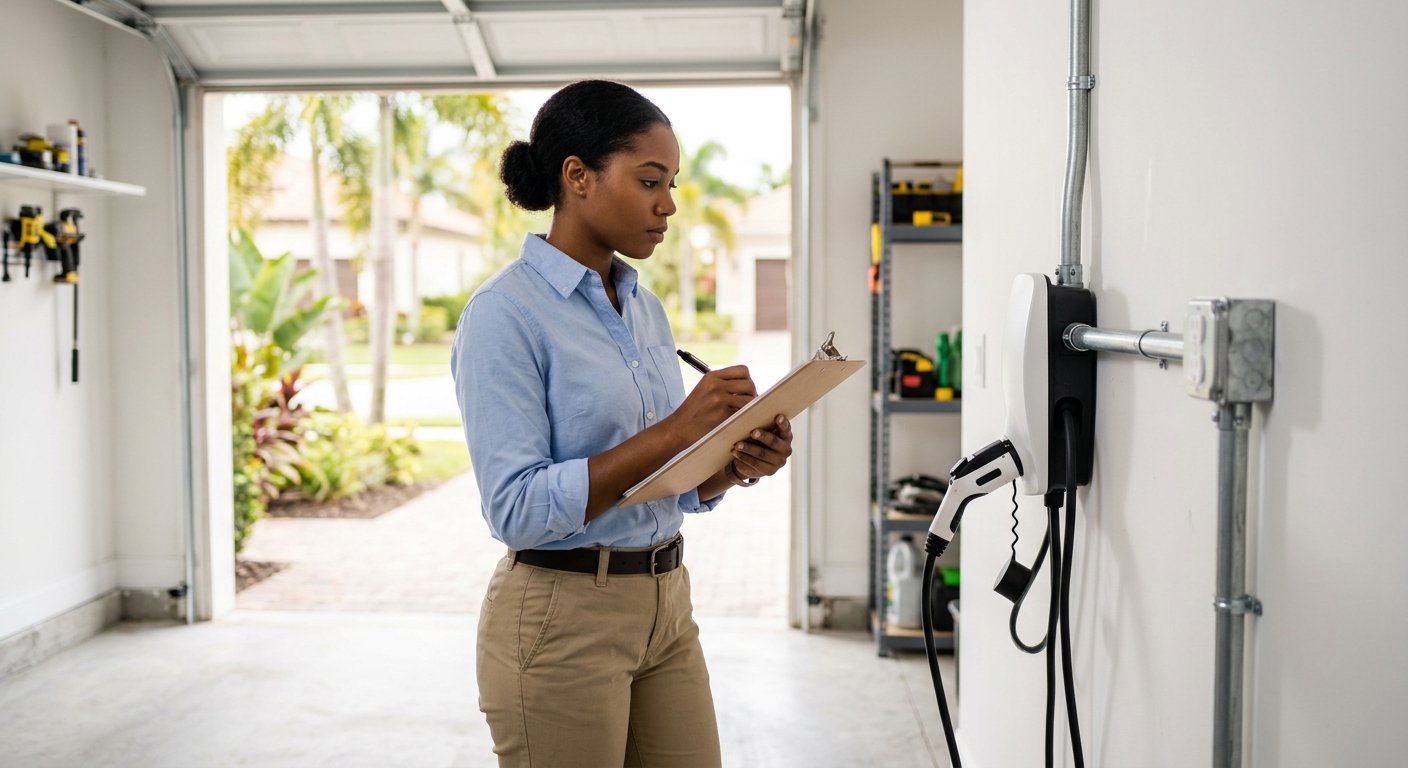
All three South Florida counties require a permit for EV charger installation. This isn’t bureaucratic red tape — it’s a critical consumer protection. A permitted installation is inspected by a local building official, which confirms the wiring, breaker sizing, and mounting are code-compliant. If you ever file a homeowner’s insurance claim involving your electrical system and the work was done without permits, coverage can be denied.
The Florida Building Code governs electrical installations statewide and adopts the National Electrical Code (NEC) as its baseline. Any licensed electrical contractor operating in Palm Beach, Broward, or Miami-Dade is required to pull permits for this type of work. At Global Power & AC Corp, we handle the entire permitting process as part of every EV charger installation — you don’t have to navigate county offices on your own.
Never accept a quote from an electrician who offers to skip the permit “to save time.” Unpermitted electrical work can void your homeowner’s insurance, complicate a future home sale, and — most critically — leave a safety hazard hidden behind your walls.
Outdoor vs. Garage Installation: What South Florida Demands
Many South Florida homes, especially in Miami-Dade and coastal Broward communities, rely on carport or driveway parking rather than enclosed garages. Outdoor EV charger installation is entirely feasible, but it introduces requirements that interior installs don’t face.
Key Considerations for Outdoor Charger Placement
- NEMA 3R or 4X enclosures: Outdoor chargers and their electrical boxes must be rated for weatherproof use. South Florida’s combination of rain intensity, salt air, and humidity accelerates corrosion on inadequately rated equipment.
- Conduit protection: Exposed wiring runs must be in rigid metal or PVC conduit approved for outdoor use. This also protects the circuit from physical damage during lawn maintenance or minor storm debris.
- Surge protection: Lightning strikes are frequent throughout Palm Beach and Broward counties during summer storm season. A whole-home surge protector — or at minimum a dedicated surge device on the EV circuit — is a wise addition.
- Charger mounting height: The charger should be mounted high enough to keep the connector and cable out of standing water, which is common after heavy rainfall in low-lying South Florida neighborhoods.
These aren’t considerations you want to figure out after installation. A local electrician familiar with South Florida conditions will spec the right equipment from the start. Our team at Global Power & AC Corp has installed home EV charging stations throughout the region, and we know exactly which products hold up in this climate.
How the Installation Process Works
Electrical assessment
A licensed electrician inspects your panel, calculates your existing load, and determines whether your system can support a new 240V circuit. This takes 30–60 minutes on site.
Panel upgrade (if needed)
If your panel lacks capacity, an upgrade is scoped and scheduled. This can often be bundled with the charger installation to reduce overall project time. See our panel upgrade services for details.
Permit application
Your electrician submits permit applications to the relevant county building department. Global Power & AC Corp manages this on your behalf.
Circuit installation and charger mounting
Once permits are approved, the dedicated circuit is run, conduit is installed where required, and the charger unit is mounted and wired. Most installations are completed in a single day.
Inspection and sign-off
A county inspector verifies the work meets code. After passing inspection, your installation is officially complete and warrantied.
Smart Home Integration and Future-Proofing
Many modern Level 2 chargers connect to your home Wi-Fi and can be managed through a smartphone app — scheduling charges during off-peak rate windows, monitoring energy use, and receiving alerts remotely. If you’re already exploring smart home electrical integration, your EV charger can be part of a coordinated energy management system that includes smart panels, automated loads, and backup power.
Planning for the future also means thinking about amperage now. If you anticipate a second EV in the household or a higher-range vehicle down the road, installing a 50-amp circuit today — even if your current charger only draws 32 amps — leaves you room to grow without rewiring.
Frequently Asked Questions
Do I need an electrical panel upgrade to install a Level 2 EV charger?
Not always. If your panel is rated at 200 amps and has available capacity, a dedicated circuit can typically be added without a full panel upgrade. However, older 100-amp panels or those already near their load limit will need to be upgraded first. A licensed electrician can assess this in a single site visit.
How long does EV charger installation take?
When the electrical panel is sufficient and permits are pre-approved, most home EV charging station installations are completed in one day. If a panel upgrade is needed, the combined project may take an additional day. Permit timelines vary by county but are typically straightforward for licensed contractors who submit complete applications.
Is a permit really required for EV charger installation in South Florida?
Yes. Palm Beach, Broward, and Miami-Dade counties all require permits for 240V circuit installations, including EV chargers. Skipping permits can void your homeowner’s insurance, create complications during a home sale, and leave safety issues uninspected. Any reputable ev charger electrician will pull the necessary permits automatically.
Can I install a Level 2 charger outdoors at my South Florida home?
Yes, with the right equipment. Outdoor installations require weatherproof-rated charger units, properly sealed enclosures, and conduit runs appropriate for exterior exposure. Given South Florida’s humidity, salt air, and frequent thunderstorms, proper equipment selection is especially important and should be handled by a local electrician familiar with these conditions.
What is the difference between a Level 1 and Level 2 EV charger for home use?
A Level 1 charger uses a standard 120V outlet and adds only 3–5 miles of range per hour — adequate for minimal daily driving but impractical for most EV owners. A Level 2 charger operates on a dedicated 240V circuit and adds 20–30 miles per hour, typically restoring a full charge overnight. The U.S. Department of Energy confirms that home charging is where most EV energy replenishment happens, making Level 2 the practical standard.
Ready to Install Your Home EV Charger?
Global Power & AC Corp is a licensed and insured electrical contractor serving Palm Beach, Broward, and Miami-Dade counties — with same-day service available and an 8-year warranty on all workmanship. We handle permits, panel assessments, and full installation so you can start charging with confidence.

About Global Power & AC Corp
Global Power & AC Corp is a trusted electrical contractor serving homeowners and businesses throughout South Florida's Palm Beach, Broward, and Miami-Dade counties. The company specializes in residential electrical services including panel upgrades, EV charger installation, standby generators, smart home integration, and comprehensive electrical safety solutions. With a commitment to quality craftsmanship backed by an 8-year warranty and same-day service availability, Global Power & AC Corp combines family-owned values with corporate-level professionalism to deliver reliable electrical solutions tailored to South Florida's unique climate challenges. Visit globalpowerpb.com →