
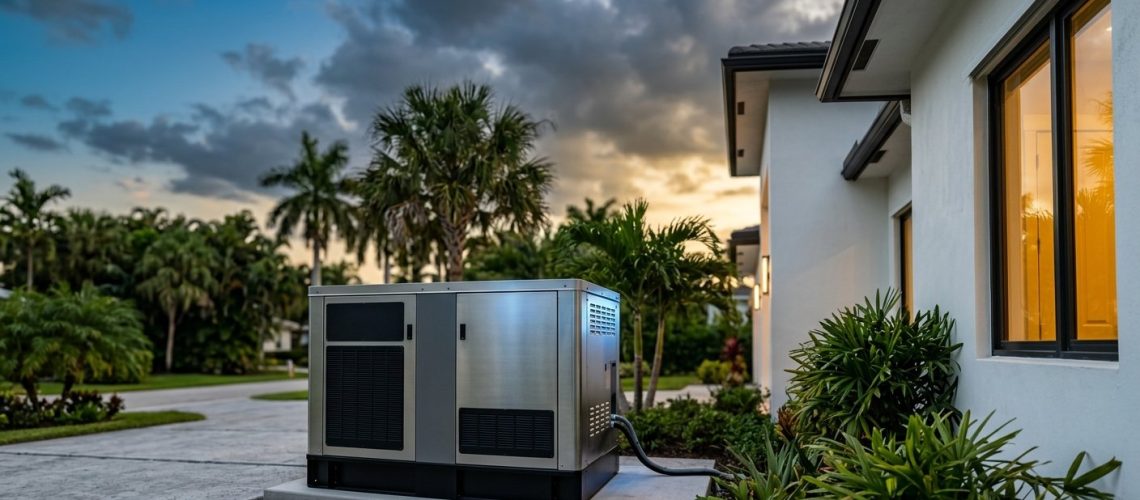
For Palm Beach, Broward, and Miami-Dade homeowners, standby generator sizing comes down to one load calculation: your HVAC system, critical appliances, and home square footage determine whether a 10–14 kW, 16–22 kW, or 24–36 kW unit is right for you. Buy too small and your AC shuts off mid-storm; buy too large and you overspend on capacity you’ll never use.
- A professional load calculation — not a rule of thumb — is the only reliable way to size a standby generator for your home.
- Central AC is the single largest load driver in South Florida, drawing 3,500–5,000 watts at run time plus a 2–3× startup surge.
- Whole-house systems (10–36 kW+) run on natural gas or propane indefinitely; essential-circuit configurations with a 14–20 kW unit offer a cost-effective alternative.
- Total installed costs range from $5,000 for a small system to $20,000+ for large estates, including permits, transfer switch, and fuel-line connection.
- All standby generator installations require permits and a licensed electrical contractor under Florida Building Code and NFPA 70.
Nearly 2.7 million Florida customers lost power during Hurricane Ian — and many of them had no backup plan. If you live in Palm Beach, Broward, or Miami-Dade County, losing power isn’t a hypothetical. It’s a matter of when, not if. That’s exactly why standby generator installation has become one of the fastest-growing home investments across South Florida. But many homeowners get tripped up buying the wrong size. Too small, and your air conditioning shuts off during a multi-day outage. Too large, and you’ve overspent on capacity you’ll never use. Getting sizing right is the most important decision in the entire process — and it’s one that licensed electrical professionals can help you get exactly right the first time.
Why Sizing a Standby Generator Isn’t Guesswork
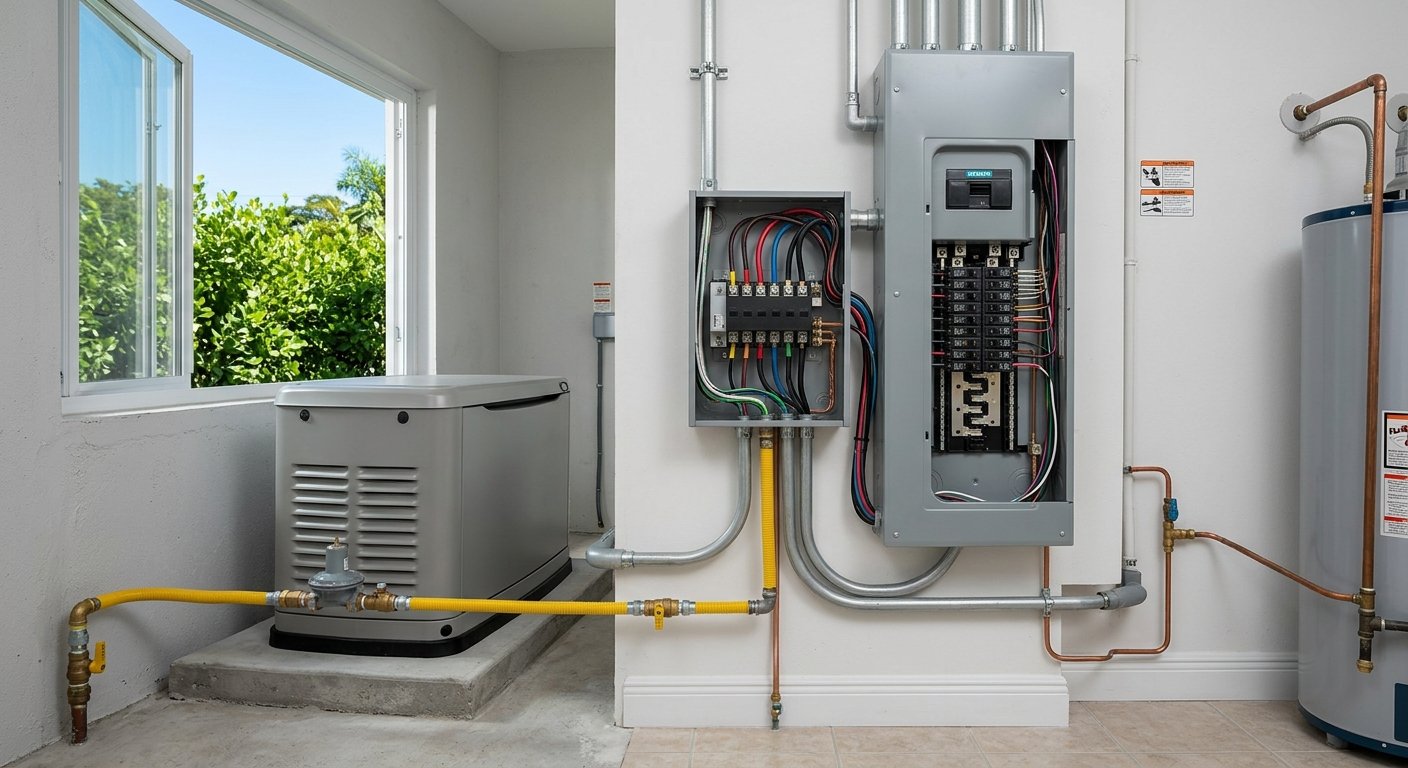
A whole house generator isn’t like buying a portable unit from a hardware store. An automatic standby generator is a permanent, hardwired system that detects a power outage and turns on within seconds — automatically. It’s connected to your home’s electrical panel and powered by natural gas or propane, meaning it can run indefinitely as long as fuel is available.
Because it’s integrated directly into your electrical system, sizing must be based on your home’s actual electrical load. Installing an undersized unit means the generator overloads and shuts down when demand spikes. Installing an oversized unit leads to “wet stacking” — a mechanical problem caused by consistently running an engine below its optimal capacity — along with unnecessary installation and fuel costs.
Proper generator sizing starts with a load calculation, which accounts for everything your home needs to run comfortably and safely during an outage.
What South Florida Homes Actually Require
South Florida homes have specific power demands that differ from homes in cooler parts of the country. Here’s what drives your generator sizing needs locally:
Air Conditioning — Your Biggest Load
In Palm Beach and Miami-Dade counties, air conditioning isn’t a luxury — it’s a health necessity. A central AC system for a mid-size home typically draws 3,500 to 5,000 watts just to run, plus a startup surge that can spike 2–3 times higher for a few seconds. This startup surge is often what catches undersized generators off guard. In South Florida’s heat and humidity, running without AC during an extended outage poses real health risks, especially for elderly residents and young children.
Refrigerators, Medical Equipment, and Critical Loads
A standard refrigerator draws 150–400 watts. Add a second fridge or chest freezer, and you’re looking at double that. If anyone in your household depends on medical equipment — oxygen concentrators, CPAP machines, or home dialysis — these must be factored into the sizing calculation as non-negotiable loads.
Home Size and Electrical Panel Capacity
A 2,000-square-foot home in Boca Raton has very different power needs than a 4,500-square-foot estate in Palm Beach Gardens. Larger homes typically require more circuits, larger HVAC systems, and more simultaneous appliance use. Your existing electrical panel capacity also plays a role — older 100-amp panels may need upgrading alongside generator installation to handle the load properly.
Common Generator Sizes and What They Cover
Here’s a practical overview of how different generator sizes map to real South Florida home needs:
Under NFPA 70 (the National Electrical Code, Article 220 load calculations), accurately calculating your home’s wattage needs before purchasing any backup power system is essential to ensure reliable performance and prevent equipment damage.
Whole Home vs. Essential Circuits Approach
Not every homeowner wants — or needs — to power every circuit during an outage. There are two primary approaches to backup generator installation in South Florida:
| Criterion | Whole House Generator | Essential Circuit Configuration |
|---|---|---|
| What it powers | Entire electrical system | Critical circuits only (AC, fridge, lights, outlets) |
| Homeowner effort during outage | None — fully automatic | Non-critical circuits remain unpowered; some manual management |
| Typical generator size | 16 kW and above | 14–20 kW even for larger homes |
| Best for | Modern smart homes, comfort-focused owners | Budget-conscious homeowners |
| Pool pumps, smart devices | Continue functioning normally | May be excluded from powered circuits |
Whole House Generator
A true whole house generator powers your entire electrical system without interruption. You flip no switches, manage no cords, and experience virtually no disruption. Everything from your pool pump to your smart home devices continues functioning normally. This approach offers the most comfort and convenience during hurricane power backup situations and is the most popular choice among South Florida homeowners with modern smart home systems.
Essential Circuit Configuration
A smaller generator paired with a transfer switch that selectively powers only critical circuits can be a cost-effective option for budget-conscious homeowners. An electrician installs a sub-panel dedicated to essential loads — AC, refrigerator, lights, and outlets — while non-critical circuits remain unpowered during an outage. This approach typically works well with a 14–20 kW unit even for larger homes.
Generac Generator Installation: A Leading Choice in South Florida
When it comes to automatic standby generators, Generac is one of the most widely installed brands across South Florida for good reason. Generac systems offer proven performance in humid, coastal environments, have a robust dealer and service network throughout Palm Beach and Broward counties, and carry strong manufacturer warranties.
Generac generator installation involves more than just placing a unit outside your home. The process includes permitting, precise placement, hardwired electrical connection, fuel-supply connection, and final commissioning. Here is what to expect from start to finish:
Permitting
Your licensed contractor pulls permits through your local building department — required by Florida code before any work begins.
Placement
The unit is sited to meet all setback and ventilation requirements specific to your municipality.
Electrical Connection
The generator is hardwired to your electrical panel via an automatic transfer switch so it starts within seconds of an outage.
Fuel-Line Connection
The system is tied into your natural gas or propane supply by a licensed professional.
Load Testing & Commissioning
The completed installation is tested under load and inspected to verify safe, code-compliant operation before sign-off.
The National Electrical Code (NFPA 70) governs generator installation standards across Florida, and all work must be performed by a licensed electrical contractor to ensure code compliance, safety, and warranty validity.
Generator Installation Cost: What to Expect in 2026
Homeowners frequently ask about generator installation cost before committing to a project. In South Florida, total installed costs for a standby generator system typically range as follows:
- 10–14 kW system: $5,000–$8,000 installed
- 16–22 kW system: $8,000–$13,000 installed
- 24–36 kW system: $12,000–$20,000+ installed
These ranges include the generator unit, automatic transfer switch, electrical labor, permits, and fuel line connection. Variables that affect your final cost include panel condition, fuel source availability, concrete pad requirements, and local permit fees in cities like Fort Lauderdale, Delray Beach, or Boynton Beach.
Homes with EV charging infrastructure may need to account for that additional load during sizing. If you’re planning future EV charger installation, discuss this with your electrician upfront so the generator is sized appropriately from the start.
Frequently Asked Questions
How do I know what size generator my South Florida home needs?
A licensed electrician performs a load calculation based on your home’s square footage, HVAC system size, appliances, and critical equipment. This ensures you get a properly sized system rather than guessing based on marketing specs. General sizing rules of thumb can help narrow down the range, but a professional assessment is the only reliable method.
Can I run my whole house on a standby generator during a hurricane?
Yes, if the generator is properly sized for your home’s full electrical load. A whole house generator connected through an automatic transfer switch will power your entire home seamlessly. Smaller generators can power essential circuits only, which means some non-critical loads like pool heaters or decorative lighting may need to be manually managed.
How long can a standby generator run continuously?
Most natural gas standby generators can run continuously for days or even weeks as long as fuel supply is uninterrupted. Propane systems are limited by tank capacity. After extended run times, maintenance intervals specified by the manufacturer should be followed. During South Florida hurricane season, multi-day outages are not uncommon, making natural gas the preferred fuel source in areas with reliable utility gas service.
Does standby generator installation require a permit in Florida?
Yes. Standby generator installation requires permits in all Palm Beach, Broward, and Miami-Dade county municipalities. Permits ensure the work is inspected and meets Florida Building Code and National Electrical Code requirements. A licensed electrical contractor handles the permitting process on your behalf. Skipping permits creates serious liability and can void manufacturer warranties.
What maintenance does a standby generator need?
Most automatic standby generators perform a weekly self-test cycle automatically. Professional maintenance — including oil changes, filter replacements, and load testing — is typically recommended annually or every 200 hours of runtime, following the manufacturer’s guidelines. Regular maintenance keeps your home backup power system reliable when it matters most.
Ready to Power Through the Next Outage?
Global Power & AC Corp’s licensed team serves West Palm Beach, Fort Lauderdale, and Miami-Dade County — handling everything from permitting to final inspection, backed by an 8-year workmanship warranty, with same-day service consultations available.

About Global Power & AC Corp
Global Power & AC Corp is a trusted electrical contractor serving homeowners and businesses throughout South Florida's Palm Beach, Broward, and Miami-Dade counties. The company specializes in residential electrical services including panel upgrades, EV charger installation, standby generators, smart home integration, and comprehensive electrical safety solutions. With a commitment to quality craftsmanship backed by an 8-year warranty and same-day service availability, Global Power & AC Corp combines family-owned values with corporate-level professionalism to deliver reliable electrical solutions tailored to South Florida's unique climate challenges. Visit globalpowerpb.com →