
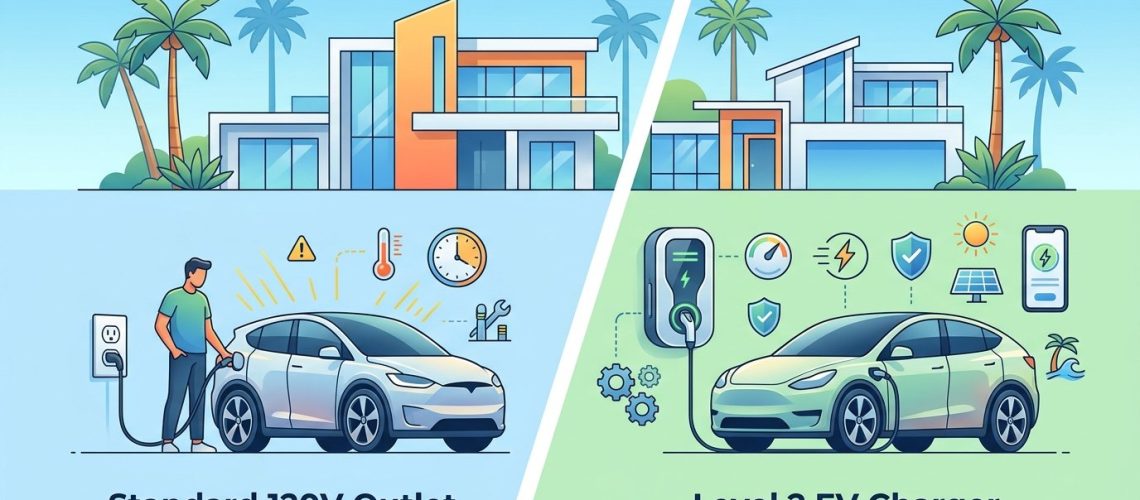
Nearly 40% of EV owners say slow charging is their biggest frustration with electric vehicle ownership — and most of them are still plugging into a standard wall outlet. If you’ve recently purchased an EV or you’re considering one, understanding the difference between a Level 2 EV charger and a basic 120-volt outlet could completely change how you experience electric driving. Let’s break it down clearly so you can make the right decision for your home and lifestyle.
What Is a Standard Outlet (Level 1 Charging)?
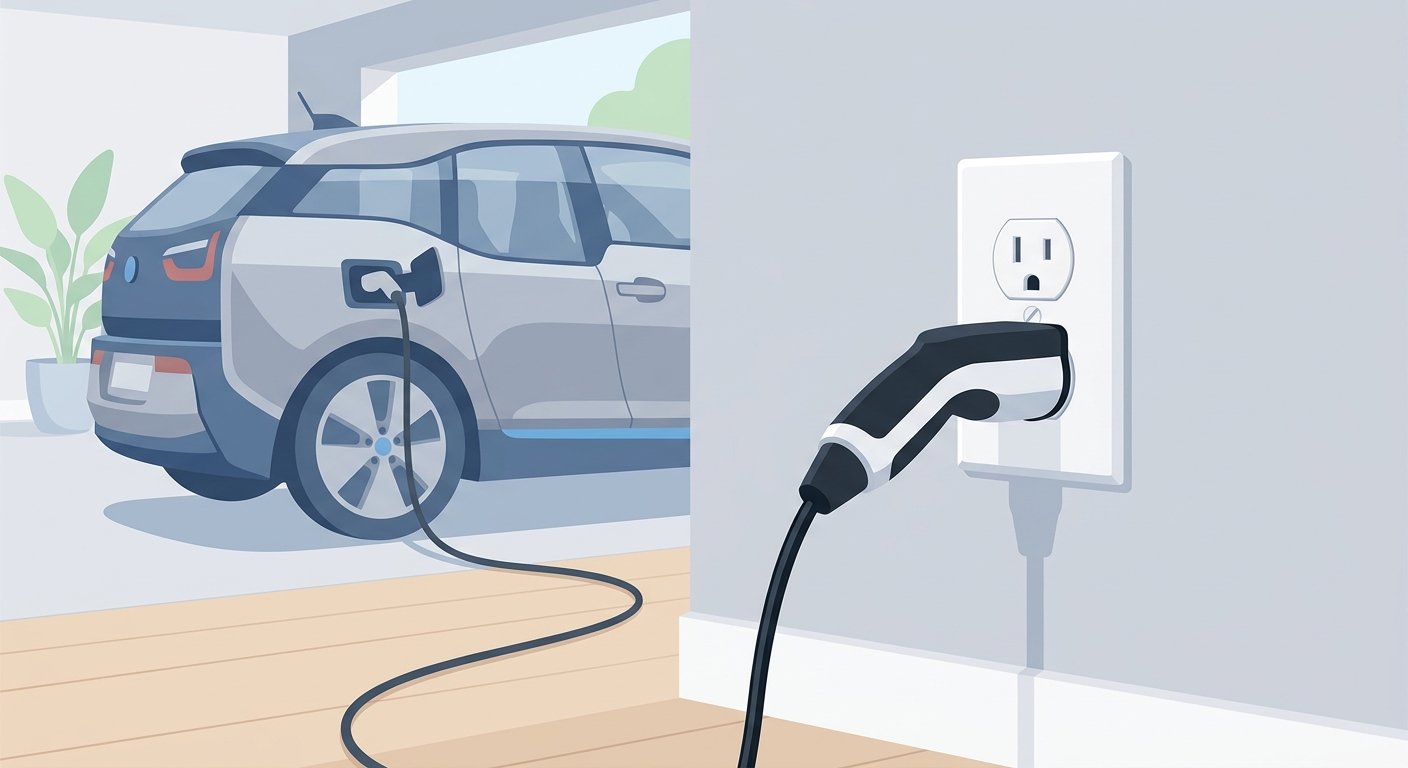
A standard 120-volt household outlet — the same one you use for a lamp or phone charger — is what’s known as Level 1 charging. Every EV comes with an adapter that allows you to plug directly into this type of outlet. No installation required, no electrician needed. Just plug in and wait.
The catch? Level 1 charging adds roughly 3 to 5 miles of range per hour. For the average South Florida commuter driving 30 to 40 miles daily, that means leaving your car plugged in for 8 to 12 hours just to replace what you used during the day. If your commute is longer, or if you occasionally take road trips, Level 1 simply cannot keep up.
There’s also an electrical concern worth noting. Running an EV charger continuously on a standard outlet can place significant strain on aging circuits — a real consideration in many older Palm Beach County and Broward County homes that haven’t had their electrical panels upgraded in years.
What Is a Level 2 EV Charger?
A Level 2 home EV charging station operates on 240 volts — the same voltage used by your dryer or electric range. This higher voltage dramatically accelerates charging speed, delivering 15 to 30 miles of range per hour depending on the charger and your vehicle’s onboard charging capacity.
In practical terms, most EV owners can fully charge their vehicle overnight with a Level 2 charger, waking up every morning with a full battery. That’s the kind of convenience that transforms how you live with an electric vehicle.
Level 2 EV chargers require professional installation. A licensed electrician will install a dedicated 240-volt circuit, mount the charging unit (either on a wall inside your garage or on an exterior surface), and ensure everything meets local electrical code requirements. According to the U.S. Department of Energy, Level 2 home charging is the most practical and recommended solution for daily EV use.
Level 1 vs. Level 2: Side-by-Side Comparison
- Voltage: Level 1 uses 120V; Level 2 uses 240V
- Miles added per hour: Level 1 adds 3–5 miles; Level 2 adds 15–30 miles
- Full charge time (avg. EV): Level 1 takes 20–40+ hours; Level 2 takes 4–10 hours
- Installation required: Level 1 requires none; Level 2 requires a licensed electrician
- Best for: Level 1 suits occasional drivers or plug-in hybrids; Level 2 suits daily EV drivers
- Upfront cost: Level 1 is minimal; Level 2 involves charger hardware plus installation
For most homeowners in Miami-Dade, Broward, and Palm Beach counties who rely on their EV for daily transportation, the choice is clear: a Level 2 home charging station is the smarter long-term investment.
Is Your Home’s Electrical Panel Ready?
Before scheduling your EV charger installation, there’s one critical step: evaluating your electrical panel. A Level 2 charger requires a dedicated 240-volt, 40- to 50-amp circuit. Older homes — and South Florida has many — may have panels that are already stretched thin or simply don’t have the capacity to support an additional high-draw circuit safely.
If your home still has a 100-amp panel, it may be time to consider a panel upgrade before or alongside your EV charger installation. A qualified EV charger electrician will assess your current electrical system and let you know exactly what’s needed. Attempting to add a 240-volt circuit to an undersized or overloaded panel is a safety hazard — not a shortcut worth taking.
South Florida’s climate adds another layer of importance here. Humidity, salt air, and frequent thunderstorms accelerate electrical wear. Having a professional inspect your panel as part of the EV charger installation process is smart preventative care that protects your entire home’s electrical system.
South Florida-Specific Considerations
Storm Season and Power Resilience
Living in Palm Beach, Broward, or Miami-Dade county means hurricane season is a real planning factor. If your area loses power during a storm, your EV charger is offline — and so is your transportation. Many South Florida homeowners are pairing their EV charger installation with a standby generator to ensure they maintain charging capability even during outages. It’s a forward-thinking combination that keeps your home resilient year-round.
Garage vs. Outdoor Installation
Most South Florida homes with garages will install a Level 2 charger on an interior garage wall — protected from the elements and convenient for nightly charging. Homes without enclosed garages may require a weatherproof outdoor unit rated for Florida’s humidity and rain exposure. Either way, the installation should be handled by a licensed and insured electrical contractor familiar with local code requirements.
HOA and Condo Considerations
If you live in a condo or planned community — common throughout Boca Raton, Delray Beach, and Fort Lauderdale — you’ll want to check with your HOA before installation. Florida law does provide EV charging rights for condo and HOA residents under Florida Statute 718.113, but the process still requires coordination and proper permitting. A professional electrician experienced in EV charger installation can help navigate this smoothly.
The Cost of Level 2 EV Charger Installation
Installation costs vary based on your home’s electrical setup, the charger brand and amperage, and how much wiring work is required. Generally, homeowners in South Florida can expect the total project cost — hardware plus professional installation — to fall within a range that most EV owners recoup through fuel savings within two to four years.
The federal government currently offers a tax credit for EV charger installation as part of the Inflation Reduction Act’s clean energy incentives. Check with a tax professional for the most current guidance, as these programs can significantly offset your upfront costs.
What you should never do is cut corners by hiring an unlicensed installer or attempting a DIY approach on a 240-volt circuit. Beyond the safety risks, unpermitted electrical work can create serious problems when you sell your home or file an insurance claim.
Why Professional EV Charger Installation Matters
Hiring a qualified EV charger electrician isn’t just about having the technical skill to run wire. It’s about making sure your installation is permitted, inspected, and compliant with Florida’s electrical code. It’s about protecting your home, your vehicle, and your family from fire risks, circuit overloads, and equipment damage.
At Global Power & AC Corp, our licensed and insured team handles every aspect of your EV charger installation from start to finish — panel evaluation, permit pulling, dedicated circuit installation, charger mounting, and final inspection coordination. We serve homeowners and businesses throughout Palm Beach, Broward, and Miami-Dade counties, and we back every installation with our 8-year warranty on workmanship. Same-day service is also available for qualified projects.
Frequently Asked Questions
Can I install a Level 2 EV charger myself?
Installing a Level 2 EV charger requires working with 240-volt electrical circuits, which must be performed by a licensed electrician and permitted through your local municipality. DIY installation is not only dangerous but may also void your charger’s warranty and create issues with home insurance or future property sales. Always hire a licensed professional for this type of work.
How long does a Level 2 EV charger installation take?
For most homes with adequate panel capacity and a straightforward installation path, a Level 2 charger can typically be installed in a single day. If a panel upgrade is also required, the project may take an additional day. A site assessment by a qualified electrician will give you a clear timeline before work begins.
Will a Level 2 charger work with any electric vehicle?
Yes. All modern electric vehicles sold in the United States are compatible with Level 2 (240-volt SAE J1772) charging. If you drive a Tesla, you’ll use an adapter, which Tesla provides, to connect to a standard Level 2 charger. Your vehicle’s onboard charger determines the maximum rate it can accept.
Do I need a permit to install a home EV charging station in Florida?
Yes. In Florida, adding a new 240-volt dedicated circuit requires an electrical permit and inspection. This ensures the work meets the National Electrical Code and local amendments. A licensed electrical contractor handles the permitting process on your behalf as part of a professional installation.
What if my electrical panel can’t support a Level 2 charger?
If your panel is at capacity or too old to safely support a new 240-volt circuit, a panel upgrade may be necessary before EV charger installation. This is a common situation in older South Florida homes. Your electrician will assess your panel during the initial evaluation and recommend the most cost-effective path forward.
Ready to Upgrade Your Home Charging?
Making the switch from a standard outlet to a Level 2 home charging station is one of the most practical upgrades an EV owner can make. Faster charging, greater convenience, and a safer electrical setup — it’s an investment that pays off every single day.
Global Power & AC Corp is here to make the process simple and stress-free for homeowners and businesses throughout Palm Beach, Broward, and Miami-Dade counties. Our team of licensed electricians brings professional expertise, transparent communication, and the quality craftsmanship backed by our 8-year warranty.
Call us today at (561) 203-0080 to schedule your EV charger installation consultation. Same-day service is available — because waiting shouldn’t be part of your EV experience.